AI in Ukraine’s Civil Society Sector: 6 Dimensions of Organizational Maturity
How civil society and charitable organizations can assess their readiness for systematic use of artificial intelligence and identify the next steps.
Artificial intelligence is becoming increasingly integrated into the work of Ukraine’s civil society sector. Teams use ChatGPT and other AI-powered tools to prepare grant applications and reports, support communications and translation, analyze information, and work with documents and data.
However, the use of AI by individual employees does not yet mean that an organization is ready for its systematic implementation.
There is a significant difference between “we use ChatGPT” and a situation where AI is genuinely integrated into workflows, supports decision-making, and creates measurable value.
That is why today it is more important to ask not “Does our organization use AI?” but:
“How ready is our organization to use AI systematically, safely, and with tangible results?”
From Individual Tools to Systemic Change
Oleh Spotykailo, UKAP expert in digital transformation and automation, analyzed current international approaches to assessing organizational readiness for artificial intelligence and, together with the UKAP team, considered them through the lens of the practical needs of Ukraine’s civil society sector.
Current approaches suggest assessing not only whether AI tools are available, but the readiness of the organization as a whole: its people, processes, data, technologies, governance systems, and ability to achieve measurable results.
For civil society and charitable organizations, we propose considering six interconnected dimensions of maturity: people, processes, data, technology, governance, and results.
Importantly, these are not sequential stages. An organization may be strong in data management but lack sufficient security rules, or it may actively use AI without yet measuring its practical results. All six dimensions should therefore be assessed together.
1. People and Skills
The starting point should be people, not technology.
In many organizations, employees already use ChatGPT, Gemini, Copilot, and other tools independently. They draft emails, translate documents, analyze information, create presentations, work on grant applications, or use AI to process large volumes of text.
It is therefore important to understand what tasks the team already uses AI for, how well employees understand its capabilities and limitations, and whether they can critically verify the outputs they receive.
Another important issue is confidential information. An employee may treat AI as an ordinary work tool and upload documents without considering what data they contain or whether those data may be shared with an external service.
Organizations therefore need not only to teach teams how to use AI, but also to build a culture of responsible technology use.
Maturity in this area means that the team understands where AI can help, where its outputs must be verified, what data must not be shared, and when the final decision must remain with a person.
2. Processes
The next dimension is how the organization works today.
In the civil society sector, a significant share of team time may be spent on repetitive manual work: searching for and analyzing funding opportunities, preparing applications, managing projects, procurement, processing monitoring results, handling requests and feedback, preparing donor reports, document management, communications, and knowledge management.
These are often the areas where AI and automation can deliver the most practical benefits.
For example, AI can help analyze large volumes of documents, summarize survey results, prepare initial drafts of reports, structure information, or locate relevant data.
However, it is important to remember that not every process should be automated, and not every automation requires artificial intelligence.
Sometimes a properly configured digital form, database, or automated sequence of actions solves the problem faster, more cheaply, and more reliably.
The right starting point is therefore not the question “Where can we use AI?” but “Where is the problem in our processes?”
Process and need come first. Technology comes second.
3. Data
The capabilities of artificial intelligence depend directly on the data an organization works with.
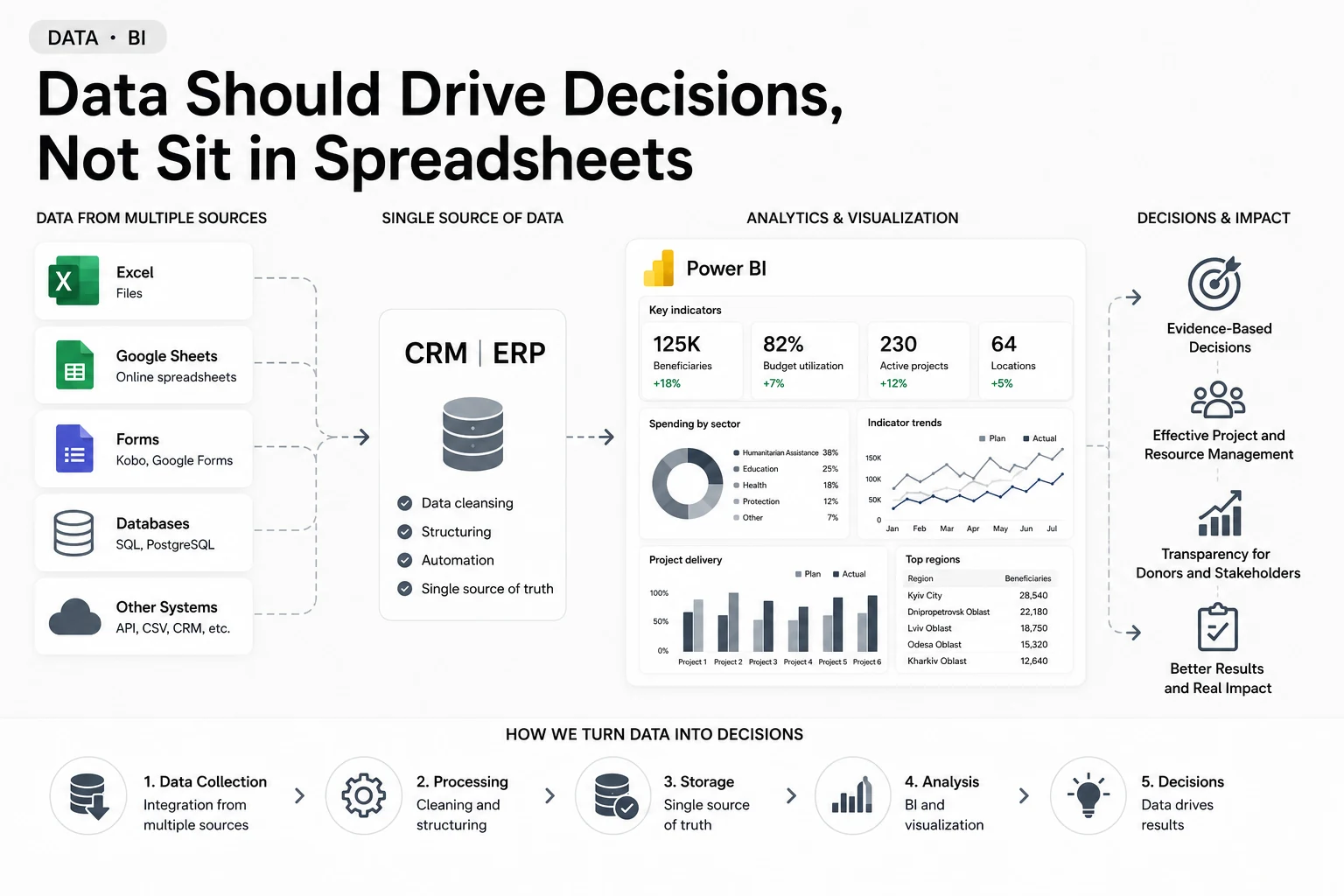
If information is scattered across spreadsheets, email, cloud storage, local files, forms, different information systems, and employees’ personal folders, systematic use of AI becomes much more difficult.
This is particularly relevant for Ukrainian civil society organizations. A single team may simultaneously implement several projects, work with different donors, use different reporting formats, and collect data through several systems.
As a result, the same information may be duplicated, transferred manually, or exist in different versions.
Before implementing complex AI-based solutions, organizations should answer some basic questions: Where is our data stored? How structured is it? Who is responsible for its quality? Is information duplicated? Which systems can exchange data? Which data can be used with AI, and which cannot?
Artificial intelligence does not automatically fix data problems. On the contrary, poor-quality, incomplete, or unstructured data can lead to poor-quality results. High-quality, structured, and accessible data are therefore one of the foundations of mature AI use.
4. Technology and Integration
A large number of digital tools does not in itself indicate digital maturity.
An organization may use Microsoft 365, Google Workspace, spreadsheets, customer or stakeholder relationship management systems, analytics tools, digital forms, project management systems, and several AI-powered services — while employees still manually transfer information from one place to another.
It is therefore important to assess not the number of applications, but how well they can work together.
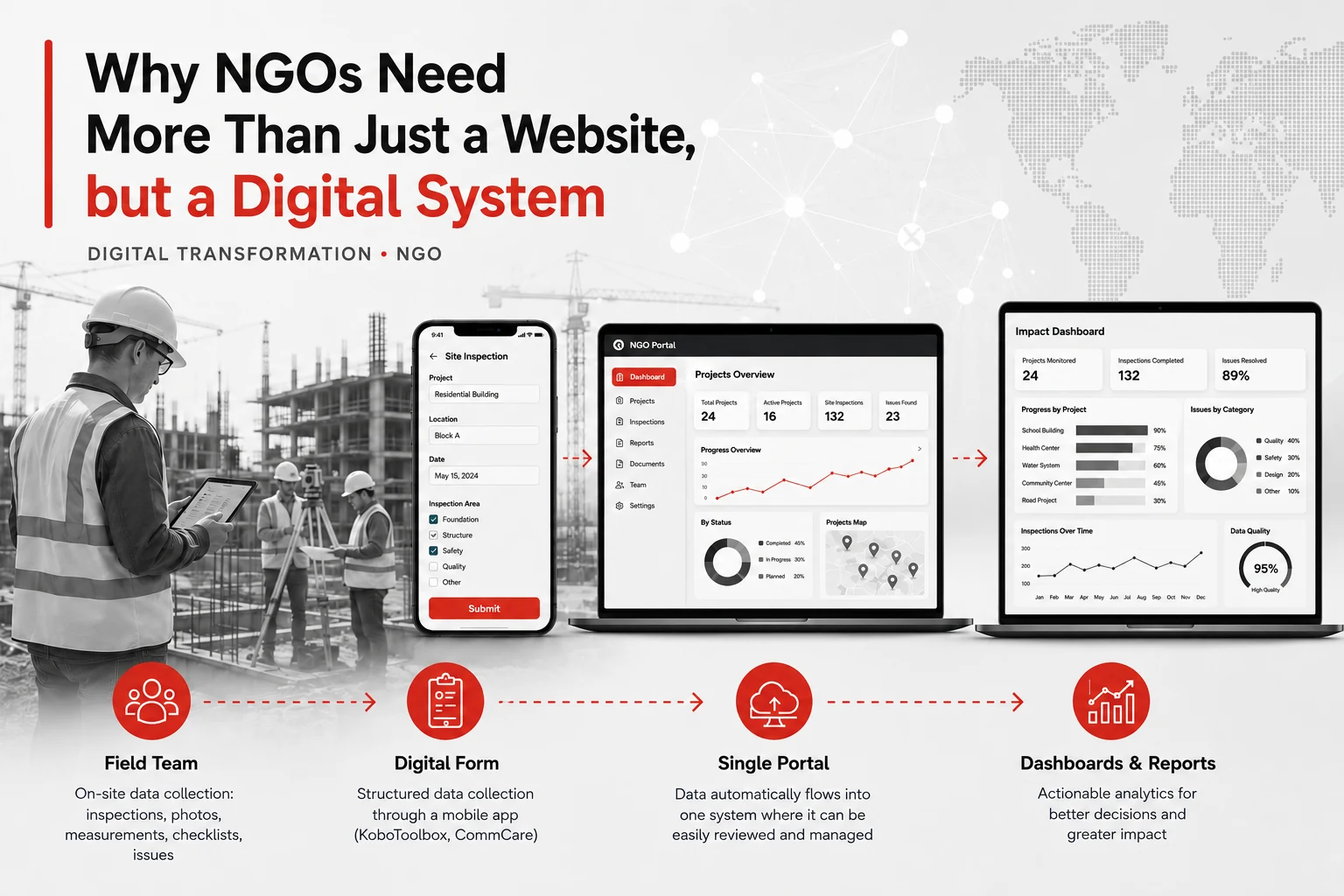
For example, data from a digital form can automatically flow into a single database, undergo validation, be processed with AI, and appear on an analytics dashboard. The responsible employee would then receive a notification only when their attention or decision is required.
Similarly, a new funding opportunity can automatically undergo an initial analysis, be compared against the organization’s defined criteria, and then be forwarded to the responsible manager for a final decision.
In such cases, AI is not a standalone tool but part of an integrated workflow.
Integration makes it possible to reduce manual operations, avoid duplication of information, and turn separate digital tools into a coherent system.
5. Governance, Security and Accountability
For the civil society sector, this is one of the most important dimensions.
Organizations may work with beneficiaries’ personal data, information about children and vulnerable groups, financial documents, donor reporting, needs assessment results, and other sensitive information.
Active use of AI without clear rules can therefore create new risks.
Organizations should define which tools may be used, what data may be shared with them, what data must not be shared, who verifies AI-generated outputs, and who is accountable for the final decision.
It is especially important to identify processes in which decisions must not be made automatically.
For example, AI may help structure or summarize information, but decisions affecting an individual, the allocation of assistance, partner assessment, or other sensitive matters should include appropriate oversight by a responsible person.
Over time, organizations need their own rules for the use of artificial intelligence.
These rules should not become just another document stored in a shared folder. They should give the team clear answers about what can be done with AI, what cannot, and who is responsible for what.
6. Results and Impact
The most important maturity question is: what has actually changed after AI was introduced?
Not the number of software tools purchased. Not the number of assistants created. And not even the number of training sessions delivered.
What matters is the practical result.
Has the time required to prepare reports decreased? Are there fewer manual operations? Can the team process information faster? Have errors decreased? Has data quality improved? Are management decisions faster and better informed?
And ultimately, has the team gained more time for work directly connected to the organization’s mission?
For example, if automation reduces the preparation of a monthly report from two working days to a few hours, that is a measurable result.
If a system helps identify problems in project implementation more quickly, it already improves management quality.
If employees spend less time transferring information between spreadsheets and more time working with communities, partners, or beneficiaries, technology begins to serve the organization’s mission.
This is where AI stops being a technology experiment and starts creating real organizational value.
Maturity in AI use is not about the number of tools, but about an organization’s ability to apply technology where it genuinely creates value. For the civil society sector, this means less time spent on routine operations, better use of data, and more capacity for programs and work with people. Ultimately, what matters is not how much AI an organization uses, but what it is able to do better because of it.
About the Author
Oleh Spotykailo — UKAP expert in digital transformation and automation.
This article was prepared based on an analysis of current international approaches to assessing organizational readiness for artificial intelligence, as well as the UKAP team’s practical experience in digital transformation, data management, and process automation.
Sources and Materials
In preparing this article, we analyzed international approaches to assessing organizational maturity and readiness for artificial intelligence, including Gartner materials on organizational AI maturity, as well as NetHope research on AI governance and responsible use in the nonprofit sector.